
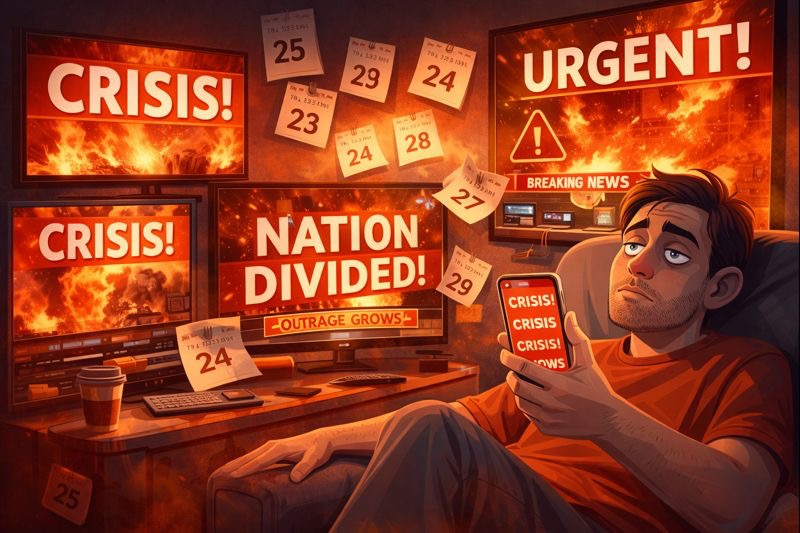

Australia awoke furious again this morning, though nobody could quite remember why. The daily outrage, now in its advanced stage, appears to be entirely self-sustaining There no longer needs to be a scandal, comment, or poorly worded tweet. “It’s all about lifestyle choice,” said one demographer,
Outrage on autopilot
The modern media cycle, long starved of patience and nuance, has developed a powerful appetite for doom. With every day framed as a crisis, every disagreement a national reckoning, every minor inconvenience a sign that society is collapsing in real time. Calm, balance, and perspective have been quietly retired, having tested poorly with advertisers and the algorithm.
The appetite for doom
When nothing happens, the media debates why nothing happened. When something small happens, it is inflated into an existential threat. When absolutely nothing happens at all, a hypothetical scenario is introduced to ensure the outrage engine never cools. “Outrage gaps are dangerous,” warned one producer. “If people stop feeling scared or angry, they might switch off.”
An expert in the field was blunt. “We don’t know what we’re angry about,” they said, “but we’re extremely confident about who’s to blame.”
Pollies keen to join the rage economy
Politicians were quick to condemn the outrage while also feeding it, warning that the nation is dangerously divided and must immediately come together to argue about it some more. Statements calling for unity were followed by interviews carefully calibrated to inflame tensions.
A think tank urged calm, cautioning that “any reduction in outrage could undermine public engagement and, more importantly, advertising revenue.”
Stay angry – just in case
At time of publication, several columnists had already pre-written tomorrow’s fury, just in case nothing happens overnight.
The nation is being urged to remain on edge, just in case someone, somewhere, was offended by something that hasn’t happened yet.


